UI / UX Design
Wazeer.AI APP
Designed the landing page and macOS dashboard for an AI Chief of Staff — an interface built to make autonomous scheduling, meeting briefs, and inbox management feel transparent and trustworthy.
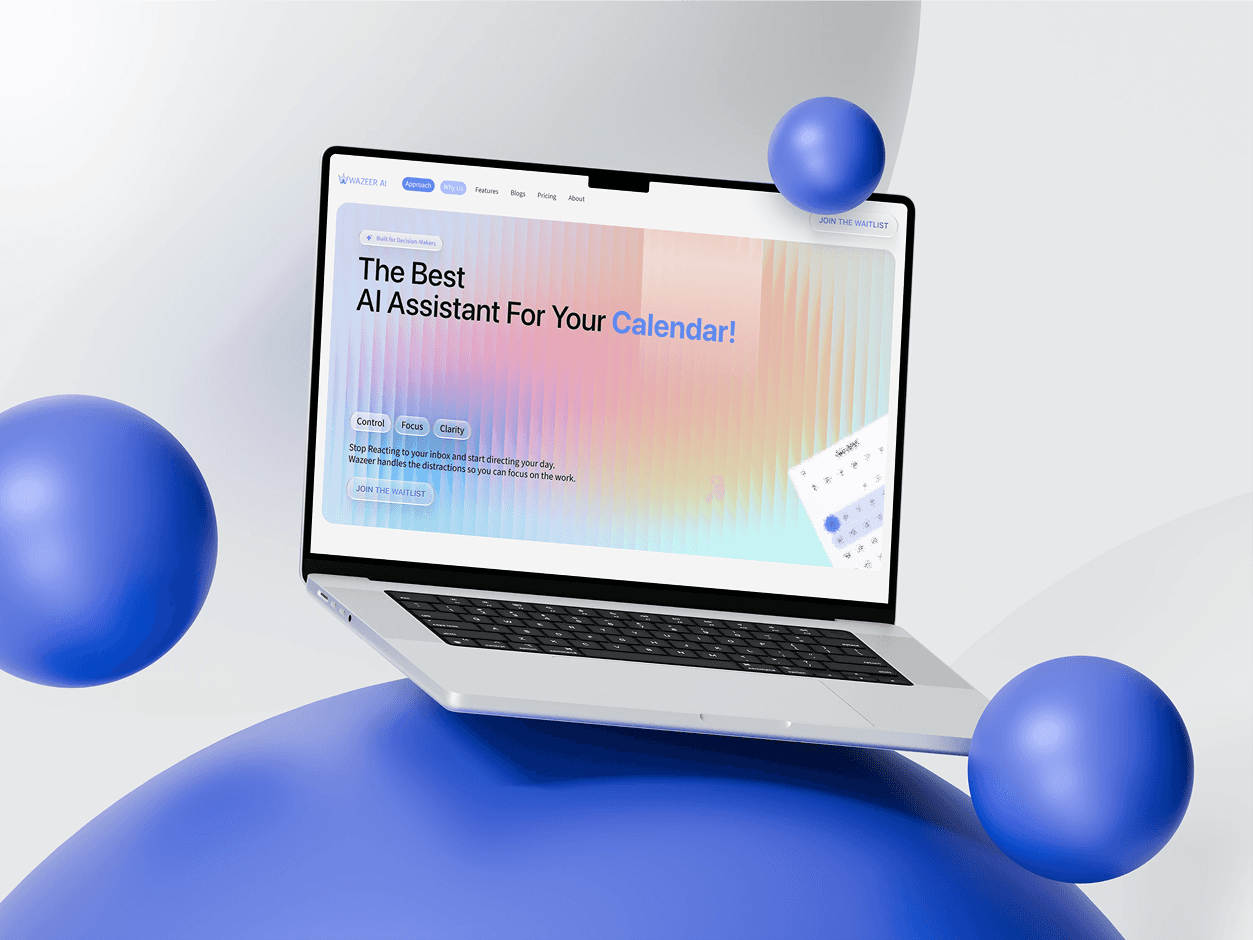
Problem :
The AI productivity market is split into two camps that both fall short: rigid algorithmic schedulers like Motion and Reclaim that optimize time but understand nothing about context, and generalist AI agents like Lindy that understand language but can't be trusted with reliable execution. Wazeer.ai was built to fill that gap - an AI Chief of Staff that negotiates meetings, briefs you before calls, and manages your inbox autonomously. But a product this ambitious creates a design problem: how do you make users trust an AI with their calendar, email, and professional reputation? The interface had to communicate intelligence without feeling like a black box, and autonomy without feeling like loss of control.
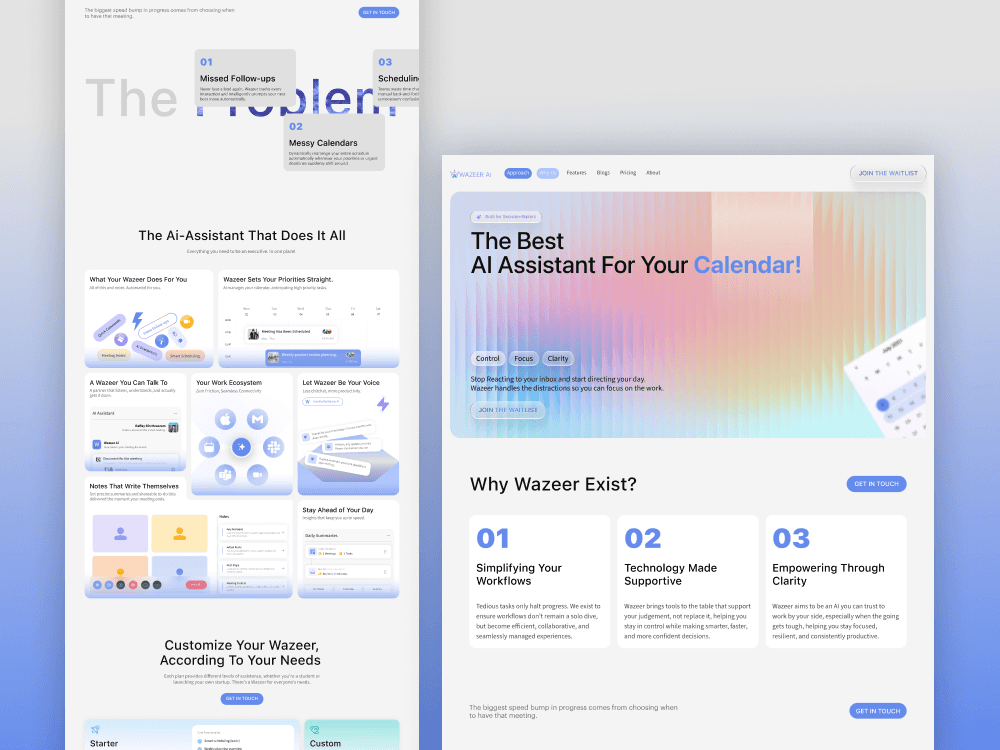
Solution :
I designed Wazeer's complete user-facing experience, the landing page and the macOS dashboard app. The dashboard was conceived as an "attention management" command center rather than another calendar grid: pre-meeting briefs surface automatically, the agent's actions are always visible and reversible, and high-stakes moves (like sending a negotiation email on your behalf) pause for one-tap human approval - making the AI's reasoning legible at every step. The landing page was structured around the product's sharpest differentiators: semantic context, active negotiation, and privacy-first architecture - positioning Wazeer against the rigidity of schedulers and the unreliability of generalist agents.
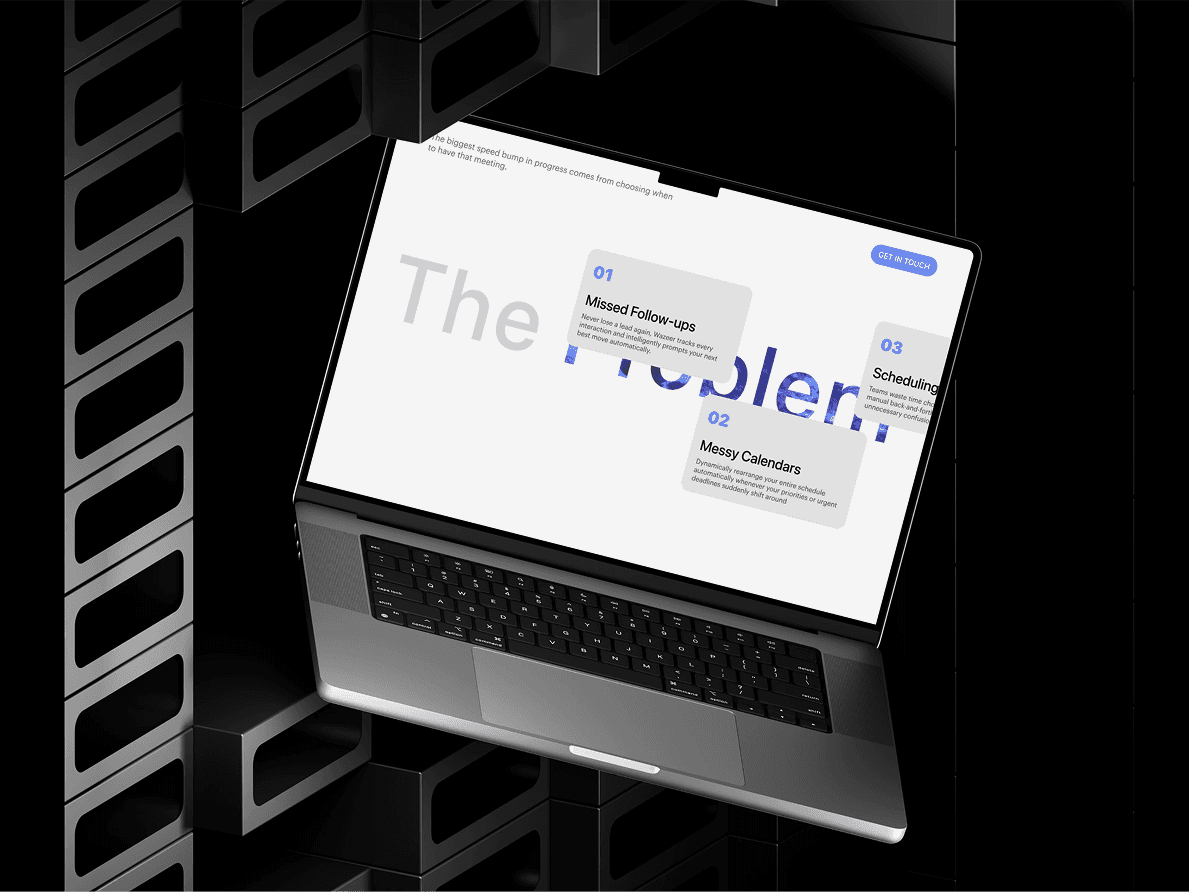
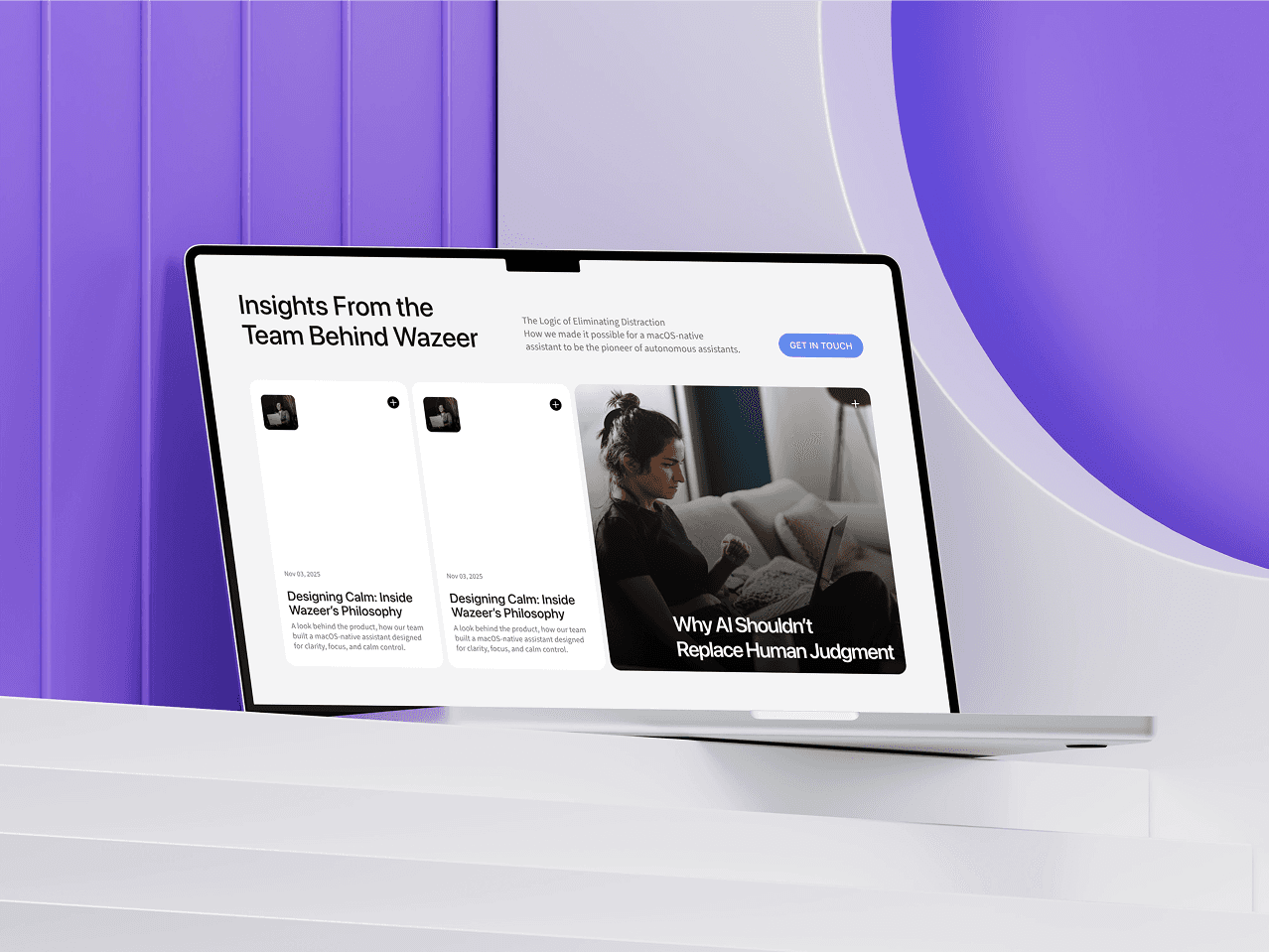
Challenge :
The core tension was autonomy versus control. An agent that asks permission for everything is useless; one that acts silently is terrifying. The design answer was a trust gradient - routine actions happen quietly with a visible activity log, while consequential ones surface as clear approval moments. Equally hard was the landing page: explaining an "AI Chief of Staff" to people burned by overpromising AI products meant showing concrete scenarios - the agent negotiating a meeting, prepping a brief - instead of abstract capability claims.
Summary :
Wazeer.ai launched with a design that makes an autonomous agent feel like a trusted colleague rather than a black box: a macOS dashboard built around transparency and human-in-the-loop control, and a landing page that converts skepticism into curiosity through demonstration over declaration.
UI / UX Design
Wazeer.AI APP
Designed the landing page and macOS dashboard for an AI Chief of Staff — an interface built to make autonomous scheduling, meeting briefs, and inbox management feel transparent and trustworthy.
Problem :
The AI productivity market is split into two camps that both fall short: rigid algorithmic schedulers like Motion and Reclaim that optimize time but understand nothing about context, and generalist AI agents like Lindy that understand language but can't be trusted with reliable execution. Wazeer.ai was built to fill that gap - an AI Chief of Staff that negotiates meetings, briefs you before calls, and manages your inbox autonomously. But a product this ambitious creates a design problem: how do you make users trust an AI with their calendar, email, and professional reputation? The interface had to communicate intelligence without feeling like a black box, and autonomy without feeling like loss of control.
Solution :
I designed Wazeer's complete user-facing experience, the landing page and the macOS dashboard app. The dashboard was conceived as an "attention management" command center rather than another calendar grid: pre-meeting briefs surface automatically, the agent's actions are always visible and reversible, and high-stakes moves (like sending a negotiation email on your behalf) pause for one-tap human approval - making the AI's reasoning legible at every step. The landing page was structured around the product's sharpest differentiators: semantic context, active negotiation, and privacy-first architecture - positioning Wazeer against the rigidity of schedulers and the unreliability of generalist agents.
Challenge :
The core tension was autonomy versus control. An agent that asks permission for everything is useless; one that acts silently is terrifying. The design answer was a trust gradient - routine actions happen quietly with a visible activity log, while consequential ones surface as clear approval moments. Equally hard was the landing page: explaining an "AI Chief of Staff" to people burned by overpromising AI products meant showing concrete scenarios - the agent negotiating a meeting, prepping a brief - instead of abstract capability claims.
Summary :
Wazeer.ai launched with a design that makes an autonomous agent feel like a trusted colleague rather than a black box: a macOS dashboard built around transparency and human-in-the-loop control, and a landing page that converts skepticism into curiosity through demonstration over declaration.
UI / UX Design
Wazeer.AI APP
Designed the landing page and macOS dashboard for an AI Chief of Staff — an interface built to make autonomous scheduling, meeting briefs, and inbox management feel transparent and trustworthy.
Problem :
The AI productivity market is split into two camps that both fall short: rigid algorithmic schedulers like Motion and Reclaim that optimize time but understand nothing about context, and generalist AI agents like Lindy that understand language but can't be trusted with reliable execution. Wazeer.ai was built to fill that gap - an AI Chief of Staff that negotiates meetings, briefs you before calls, and manages your inbox autonomously. But a product this ambitious creates a design problem: how do you make users trust an AI with their calendar, email, and professional reputation? The interface had to communicate intelligence without feeling like a black box, and autonomy without feeling like loss of control.
Solution :
I designed Wazeer's complete user-facing experience, the landing page and the macOS dashboard app. The dashboard was conceived as an "attention management" command center rather than another calendar grid: pre-meeting briefs surface automatically, the agent's actions are always visible and reversible, and high-stakes moves (like sending a negotiation email on your behalf) pause for one-tap human approval - making the AI's reasoning legible at every step. The landing page was structured around the product's sharpest differentiators: semantic context, active negotiation, and privacy-first architecture - positioning Wazeer against the rigidity of schedulers and the unreliability of generalist agents.
Challenge :
The core tension was autonomy versus control. An agent that asks permission for everything is useless; one that acts silently is terrifying. The design answer was a trust gradient - routine actions happen quietly with a visible activity log, while consequential ones surface as clear approval moments. Equally hard was the landing page: explaining an "AI Chief of Staff" to people burned by overpromising AI products meant showing concrete scenarios - the agent negotiating a meeting, prepping a brief - instead of abstract capability claims.
Summary :
Wazeer.ai launched with a design that makes an autonomous agent feel like a trusted colleague rather than a black box: a macOS dashboard built around transparency and human-in-the-loop control, and a landing page that converts skepticism into curiosity through demonstration over declaration.